Meals
Breakfast, Lunch, Dinner
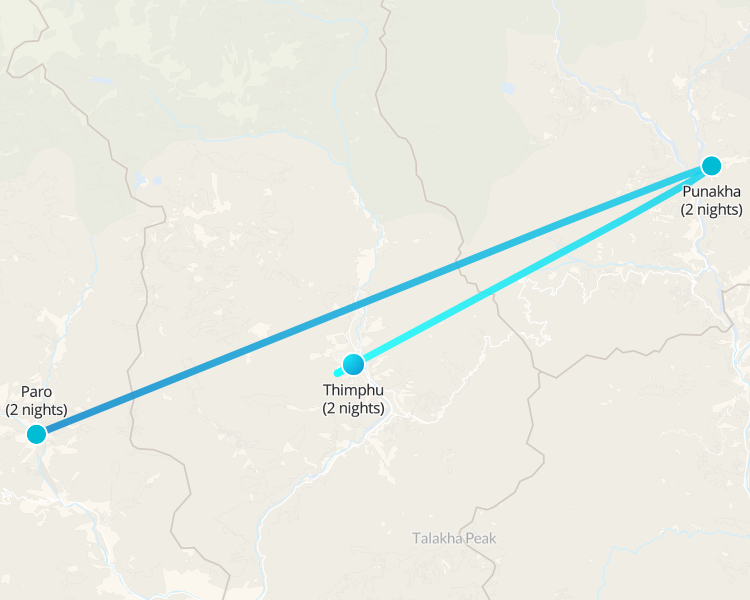
Leaving Punakha, we start our journey towards Paro via Dochula Pass. We will cover a few point of interest before we checkin to the hotel.
Paro Dzong.
Also called Rinpung Dzong, the Fortress of a Heap of Jewels. Constructed in the early 15th century as a diminutive fort, it was presented to the religious and political authority of Shabdrung Ngawang, who developed it into a much more commanding fortress in 1646. This is, without a doubt, one of the kingdom’s finest examples of traditional Bhutanese architecture. Once, great catapults here flung stones at invading Tibetans. Today the Dzong houses a monastic school. Two hundred resident monks take meals in a communal room. Several interesting paintings here include an unusual Bhutanese interpretation of a mandala, a diagram of the cosmos. We return to our transport crossing the traditional wooden covered bridge called NYAMAI-ZAM which spans the Paro River. Earlier, in times of war, the bridge was removed each time to protect the Dzong!
National Museum
Ta dzong (watchtower), built in 1649 to protect the undefended dzong and renovated in 1968 to house the National Museum. The unusual round building is said to be in the shape of a conch shell, with 2.5m-thick walls. Displays include an impressive collection of thangkas, both ancient and modern, depicting Bhutan's important saints and teachers, as well as fearsome festival masks grouped according to their tsechu dances. There's a natural-history gallery with a 3D map of Bhutan, while the Heritage Gallery contains such oddities as an egg laid by a mule and a horse horn attributed to Guru Rinpoche, plus a few original iron links from the iron bridge at Tamchhog. An underground tunnel is said to lead from the watchtower to the water supply below.
kyichu monastery.
Kyichu Lhakhang is a Buddhist temple in Paro. It is one of the oldest monasteries in the country built in the 7th century by the Tibetan King Songsten Gampo.




 Baboo Certified