In the morning we visit the Koutoubia Mosque from the outside. The "mosque of the booksellers" from the 12th century is the oldest mosque in Marrakech and one of the oldest in Morocco. Also, in the morning we visit the Saadian graves from the 16th century. Seven sultans and over 60 other Saadite members were buried in this necropolis. The mausoleums are richly decorated with filigree stucco work, fine mosaics and artistic carvings made of cedar wood. Continue to the Bahia Palace on an area of 8,000 m2, which the Grand Vizier Si Moussa had built in 1867 and which his son Bou Ahmed added a garden, a hammam and a mosque. In the shady, planted inner courtyard of the palace, the combination of pomp and structural lightness is particularly impressive.
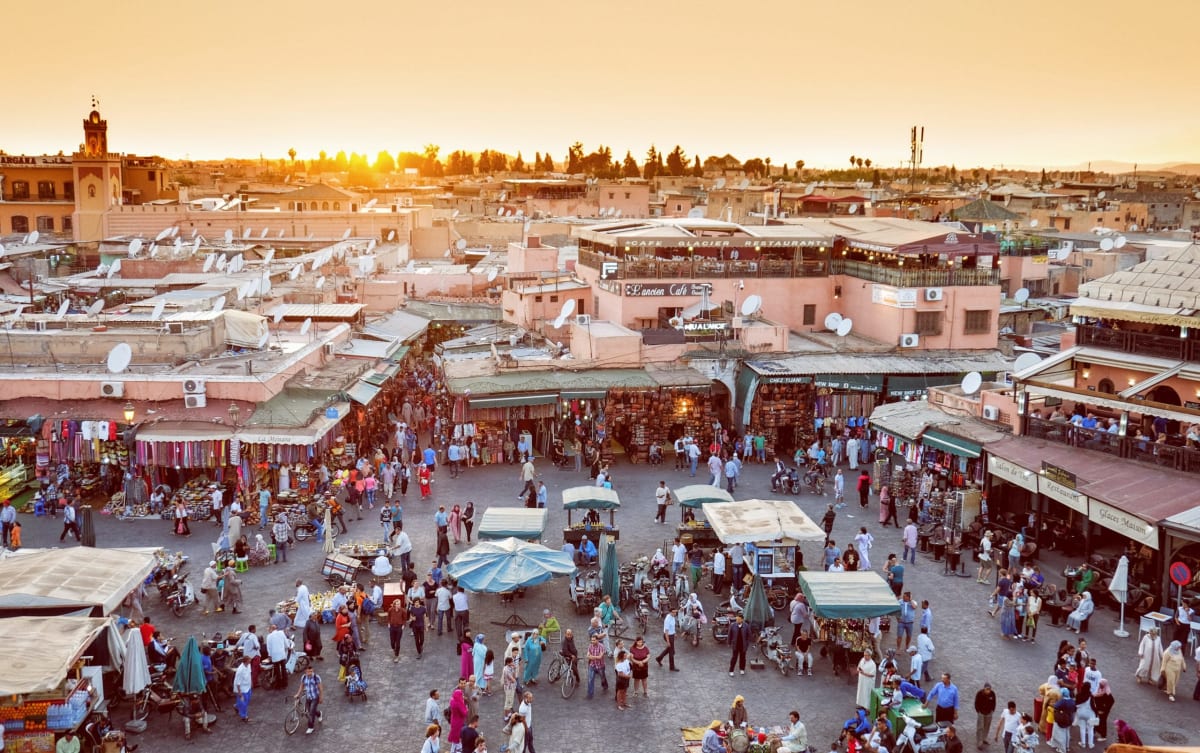
After lunch we venture into the labyrinth of souks in the medina and let our senses bewitched by smells, colors and sounds. The long stroll through the winding and busy alleys ends at the Djemaa el Fna square. At this pulsating meeting point for traders, jugglers, monkey dressmakers, musicians, dancers and storytellers, we once again immerse ourselves in a world of 1001 nights. The medina of Marrakech with the Djemaa el Fna square and the Menara and Agdal Gardens has been a UNESCO World Heritage Site since 1985.
Afternoon horse carriage ride through the city and visit of the historic botanical Majorelle gardens, which the French painter Jacques Majorelle had laid out based on the model of the palaces of Marrakech, dating from the 1920s. It is about 2 km northwest of the medina. Here you can marvel at playful watercourses and tropical plant art with cacti and bamboo from different climate zones. Also, worth seeing is the former “blue studio”, which today houses the Islamic Art Museum.







 Baboo Certified