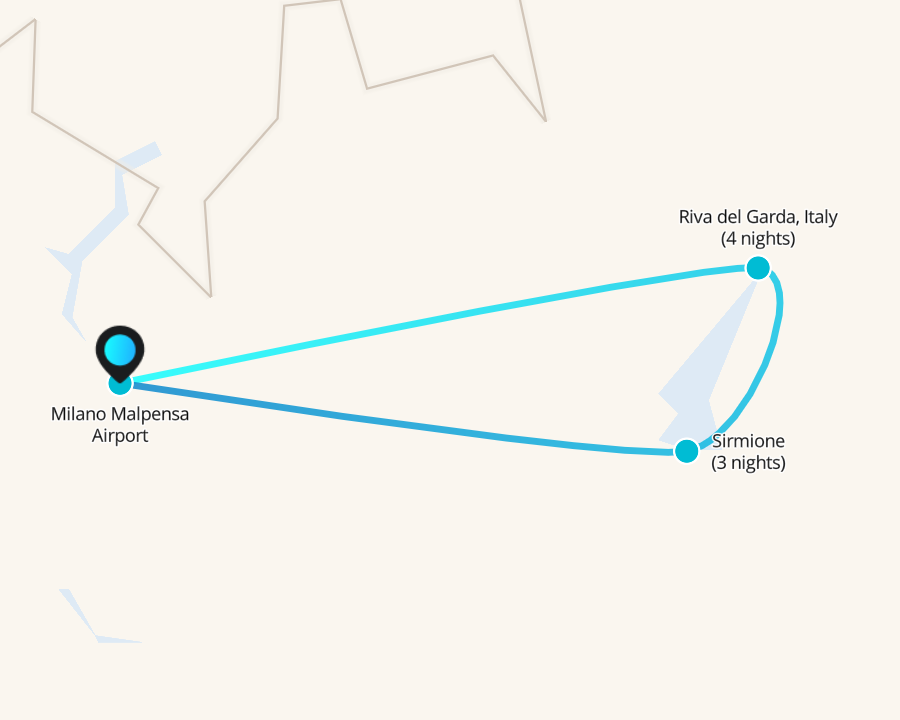
Today you drive toward Sirmione on a self-drive route with stops along the way.
Your first stop is Limone sul Garda. When the scent of citrus fills the air on Lake Garda, you are likely in Limone, the northernmost town on the Brescia side and also the northernmost place of all where lemons are grown. This ancient and atmospheric village has several places to explore during your visit.
Among its historic structures, the Limonaia del Castèl stands out for both its size and its state of preservation. It was founded in the seventeenth century with stone and wood greenhouses, then expanded in the eighteenth century to improve citrus cultivation and protect it from winter winds. Alongside the Castèl site, Limone sul Garda also has various pillar structures used for lemon growing, already noted by Goethe at the end of the eighteenth century and increasingly widespread here until the postwar period.
The Limone sul Garda bike path is a spectacular 2.5 km suspended pathway, part of the larger Garda by Bike project, that extends above the water and opens up striking lake views.
Continue to Gardone Riviera, a charming village in the province of Brescia overlooking the southern shore of the lake. The D'Annunzio lakefront is recommended if you want a romantic walk by the water.
You can visit The Vittoriale degli Italiani on your own, with entrance tickets included. This hillside estate and monumental complex was built by the poet Gabriele D’Annunzio from 1921 to 1938. It includes his eclectic house, the Prioria, as well as a war museum, an open-air theater, and notable gardens. The site commemorates his "inimitable life" and Italy’s WWI victory.
Gardone Riviera also offers many places where you can stop for an aperitif in a relaxed setting or for dinner for two. Before continuing, a walk through the ancient nucleus of the village is highly recommended, with picturesque alleys, old stairways, and colorful houses brightened by abundant flowers.
The limonaie of Lake Garda are historic lemon-growing structures developed to protect citrus trees from the area’s colder winter conditions.





 Baboo Certified