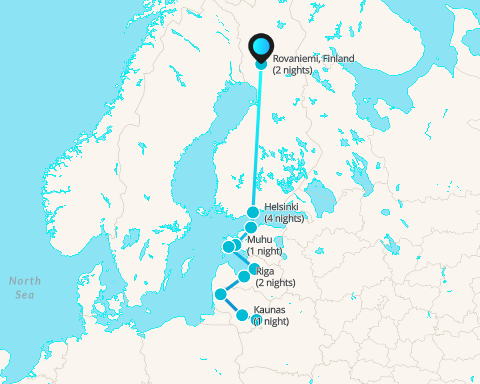
20 Day itinerary in Finland, Europe
Travel from the Arctic Circle in Rovaniemi through Finland’s forests, vibrant cities, and the Baltic states, focusing on eco-friendly practices and local culture. This journey across Finland and neighboring countries highlights natural beauty, historic towns, and unique wildlife experiences.


By Elo Zobel, Dovile and Edvinas
Physical Difficulty
Recommended Age
Operated in
GUIDANCE
starting point
trip type
trip attributes
Cultural
Visit markets
Culture & History
Start
Night
End
Experience Rovaniemi’s Arctic landscapes and Northern lights
Visit Rundale Palace’s baroque architecture in Latvia
Explore Tallinn’s medieval Old Town and vibrant districts
Cycle through Helsinki’s historic neighborhoods with a local guide
Experience Rovaniemi’s Arctic landscapes and Northern lights
Visit Rundale Palace’s baroque architecture in Latvia
Explore Tallinn’s medieval Old Town and vibrant districts
Cycle through Helsinki’s historic neighborhoods with a local guide
Accommodation Categories
Day 1: Arrival in Rovaniemi | Welcome to the Arctic Circle
Arrive at Rovaniemi Airport, where you collect your luggage and meet your driver. You are privately transferred to your centrally located hotel in Rovaniemi. After checking in, you have time to settle in and acclimate to your new surroundings.
Rovaniemi is known as the official hometown of Santa Claus and sits directly on the Arctic Circle, making it a key gateway to Finnish Lapland’s wilderness.
Accommodation:
Day 2: Rovaniemi at Leisure | Nature, Huskies, and Arctic Experiences
You have a full day to spend in Rovaniemi as you wish. You can take the city bus to Santa Claus Village, located at the Arctic Circle Marker, for a self-guided visit.
Several optional tours are available. In the morning, from 9:30 to 12:30, you may join a wellness experience focused on Finnish nature. A local guide introduces you to the Finnish lifestyle through berry picking and wild water fishing in the forest. Depending on the season, you might find cloudberries, blueberries, lingonberries, cranberries, crowberries, or edible mushrooms. After gathering these local superfoods, you relax by a campfire as your guide prepares traditional Finnish pancakes topped with fresh berries. You also have the chance to try fishing with a simple rod and hook, a common local technique, while enjoying the tranquility of the forest.
From 12:00 to 14:00, you can choose a forest walk with huskies. At the husky kennel, you are greeted by eager sled dogs. Your guide explains the life of the dogs and offers handling instructions. You learn your dog’s name and some of its tricks before heading out on an easy hike through the forest, where you might spot Arctic shrubs, berries, birds, and possibly other wildlife. After the walk, you return the dogs to the kennel and enjoy snacks and drinks around a campfire.
In the evening, from 18:30 to 20:30, you can participate in a summer biking experience using e-bikes. A local guide introduces you to electric fatbikes and leads you through Rovaniemi City, the Ounasvaara hillside, and along the riverside. The wide tires of the bike provide stability on all surfaces, making the ride comfortable and enjoyable. The guide shares insights about the area and points out natural highlights along the way.
Later, from 19:00 to 22:00, another optional activity takes you on a catamaran boat journey through serene Arctic landscapes. You reach Kotisaari, a small river island, where you prepare Lappish snacks together with your guide by an open fire. You experience the quiet brightness of an Arctic summer night, even if the sun is hidden by clouds.
Rovaniemi’s forests have been central to Finnish culture, providing food, shelter, and a sense of peace for centuries.
Accommodation:
Day 3: Lapland’s Beauty | Riverboat and Sleeper Train to Helsinki
You have the day to explore Lapland’s natural beauty with walks, hikes, or other activities of your choice. An optional excursion is available from 13:00 to 15:30: take a riverboat cruise along the Arctic Circle to a riverside reindeer farm. During the cruise, you travel through peaceful landscapes in a long wooden riverboat. At the reindeer farm, you learn about reindeer herding traditions, practice using a reindeer lasso called a ‘suopunki,’ and cross the Arctic Circle. The visit includes Lappish hospitality with coffee and traditional Finnish pastries before returning to Rovaniemi.
In the evening, you transfer to Rovaniemi Railway Station for the overnight sleeper train to Helsinki. The train features a dining car with meals and drinks available for purchase. You spend the night in a twin bunk cabin equipped with a private toilet and shower.
The overnight train from Rovaniemi to Helsinki is a classic route, connecting Lapland’s Arctic wilderness with Finland’s southern capital since the early twentieth century.
Day 4: Arrival in Helsinki | Explore the Finnish Capital
Upon arrival in Helsinki, you are met by a private car for transfer to your centrally located hotel. Breakfast is provided upon your arrival. You have time to acclimate before beginning to explore Helsinki. With your 24-hour Helsinki Card, you can access various city attractions and public transportation. You may choose to visit the Helsinki City Museum as part of your introduction to the city.
Helsinki, established in the 16th century, is renowned for its neoclassical architecture and vibrant design scene.
Meals: Breakfast
Accommodation:
Day 5: Helsinki’s Design District | Art, Parks, and Coastline
This day is set aside for you to discover the highlights of Helsinki’s Design District, known for its galleries and cafes. You may visit the Design Museum, the Sinebrychoff Art Museum, and the Kiasma Museum of Contemporary Art. The Oodi Library, often called Helsinki’s Living Room, is another recommended stop. You can also explore the city’s parks and coastline at your own pace. For a change of scenery, take the streetcar to Sibelius Park, or consider a visit to the residence and studio of architect Alvar Aalto.
Helsinki’s Design District has played a key role in making the city a UNESCO City of Design, reflecting Finland’s strong tradition in architecture and creative industries.
Accommodation:
Day 6: Helsinki’s Surroundings | National Parks or Day Trips
Today, you can further explore Helsinki or venture into the surrounding areas. Options include visiting Nuuksio National Park or Sipoo National Park, both located within the greater Helsinki region and offering opportunities for outdoor activities. Alternatively, you may travel to Porvoo, a charming small town known for its wooden houses and riverside setting, or take a train to Tampere, an inland city noted for its post-industrial character.
Porvoo is one of Finland’s oldest towns, with roots dating back to the 14th century and a well-preserved medieval old town.
Accommodation:
Day 7: Ferry to Tallinn | Arrive in Estonia’s Capital
In the morning, you are collected by taxi and transferred to the ferry terminal. You board a midday ferry for the Gulf of Finland crossing to Tallinn. Breakfast is served on board, and you have time to enjoy the sea views during the journey. Upon arrival at the port of Tallinn, a driver takes you to your hotel in the Old Town. You settle in and begin to explore the Estonian capital, taking in the beautifully preserved medieval Old Town, the impressive Dome Church, and several scenic viewpoints.
Tallinn’s Old Town is a UNESCO World Heritage Site, celebrated for its intact medieval walls, cobbled streets, and historic architecture.
Accommodation:
Day 8: Discover Tallinn | Parks, Art, and Seaside Districts
Spend the day exploring Tallinn on foot and by streetcar, focusing on the city’s western neighborhoods. Start in the Rotermann Quarter, known for its modern architecture and vibrant atmosphere, then make your way to Kadriorg Park, home to a landmark baroque palace and the Estonian Art Museum. Continue along the bedrock cliff to the Japanese Garden, and visit the Singing Revolution festival grounds. Enjoy a coastal walk at Pirita Olympic Harbor.
Explore the Kopli area, where you can browse the grocery market and visit Telliskivi Creative City, an area known for its lively cultural scene. Admire Kalamaja’s traditional wooden architecture and head to Port Noblessner, where you find the Maritime Museum and several inviting cafe terraces.
Kadriorg Palace was commissioned by Peter the Great in the 18th century and remains a symbol of Tallinn’s historical ties with Russia.
Accommodation:
Day 9: Lahemaa National Park | Estonian Nature and Heritage
In the morning, your rental car is delivered to your hotel. You set out on a road trip to Lahemaa National Park, one of Estonia’s most celebrated natural areas. Here, you hike the Viru bog and visit the fishing villages of Kasmu, known for its rocky shore and captain’s museum, Vosu with its notable beach, and Altja, which preserves local fishing traditions. You also explore the wilderness trails of the Oandu area, and visit Sagadi Manor and Palmse Manor, learning about regional distilling traditions. On your return journey, you may stop at Jagala Waterfall.
Lahemaa National Park, established in 1971, is one of Europe’s largest national parks and is renowned for its coastal landscapes, forests, and cultural heritage sites.
Accommodation:
Day 10: Road Trip to Muhu | Rummu Quarry, Haapsalu, and Matsalu
Begin your long-distance road trip across the Baltic region. Your first stop is Rummu quarry, notable for its submerged prison ruins. Continue to Haapsalu for a historic walk and lunch. Next, visit the Matsalu National Park visitor center, an area renowned for birdwatching. Afterward, take the ferry to Muhu, a picturesque fishing island in the Baltic Sea. Upon arrival, settle into a traditional guesthouse, enjoy a walk in the surrounding nature, and relax with a sauna. Dinner is available as an option.
Muhu Island is known for its preserved rural traditions and distinctive wooden architecture, offering insight into Estonia’s island culture.
Day 11: Saaremaa Island | Windmills, Cliffs, and Castles
Today you explore Saaremaa, Estonia’s largest island, where Nordic landscapes blend with a rich medieval heritage. In Angla, visit the windmill hill, then continue to Karja to see the medieval church. For those interested, additional stone churches can be found in Kaarma and Valjala. In Panga, admire expansive views from the abrupt cliff, and spend time in Kuressaare, the island’s capital, known for its castle and lively main street. If time permits, you may visit a local farm or brewery to further experience Saaremaa’s culture.
Saaremaa has been inhabited since prehistoric times and has a long history as a center of seafaring and trade in the Baltic region.
Day 12: Travel to Latvia | Coastal Drives and Manor Stay
Continue your road trip by taking the ferry from Saaremaa back to the mainland, passing through Parnu. Along the way, consider stopping for short hikes on the Tuhu and Tolkuse trails, which offer a break from driving. Once in Latvia, visit the town of Limbazi, home to an impressive silver museum. Arrive in Ungurmuiza, where you stay for two nights in Latvia’s oldest wooden manor, dating to the 18th century. The manor features preserved wall paintings and is surrounded by a park with centuries-old oaks. You can visit the Manor Museum and enjoy dinner at the on-site restaurant.
Ungurmuiza Manor is a rare example of wooden baroque architecture in Latvia, reflecting the country’s aristocratic heritage.
Accommodation:
Day 13: Gauja National Park | Castles, Caves, and River Valley
Spend the day exploring Gauja National Park, Latvia’s renowned natural area that stretches along both sides of the Gauja River. In Cesis, wander through the picturesque old town and explore the castle ruins, finding a local spot for dinner. Continue to Ligatne, where you walk nature trails along the river, discover rock exposures and caves, and observe historic wooden architecture linked to the area’s paper mill legacy. Visit the Turaida Museum Reserve, which includes a red-brick castle and a sculpture park. In the Gauja Valley, see Gutmanis Cave and the Sigulda castle ruins. Afterward, travel to Riga and settle into your hotel in the Hanseatic Old Town, marking your first experience in Latvia’s largest city.
Gauja National Park, established in 1973, is Latvia’s oldest and is celebrated for its sandstone cliffs, medieval castles, and diverse wildlife.
Accommodation:
Day 14: Riga’s Hanseatic Legacy | Old Town, Markets, and Art Nouveau
Today you embark on a self-guided walking tour of Riga’s Old Town, once a major Hanseatic port. Explore Town Hall Square, the House of Blackheads, St. Peter’s Church, the Dome Cathedral, and the Castle of Riga. Wander the cobblestone streets and open squares at your own pace. Visit Riga Central Market and the old ghetto area, then enjoy a leisurely cruise on the Riga Canal and River Daugava. Take time to admire the city’s renowned Art Nouveau architecture.
Riga holds one of the world’s largest collections of Art Nouveau buildings, many dating from the city’s economic boom in the early 20th century.
Accommodation:
Day 15: Road Trip to Lithuania | Palaces, Crosses, and Lakes
Travel south to Lithuania, passing through the Zemgale Region, historically part of the Grand Duchy of Courland. Visit Rundale Palace, a notable example of baroque architecture. Once in Lithuania, stop at the Hill of Crosses, a significant pilgrimage site. Continue through the towns of Telsiai, known for its scenic lakeside setting, and Plunge, where you find Oginski Park and a historic clock tower that houses a local library. Arrive at Zemaitija National Park and settle in the village of Plateliai, located on the shores of Lake Plateliai.
The Hill of Crosses near Siauliai has been a symbol of Lithuanian faith and national identity since the 19th century, with thousands of crosses placed by pilgrims over generations.
Accommodation:
Day 16: Zemaitija National Park | Cycling, Museums, and Lake Plateliai
Spend the day exploring Zemaitija National Park around Lake Plateliai. You can follow the 24-kilometer paved and dedicated circular bike route to experience the area’s landscapes. Recommended stops include the Shrovetide mask exhibition, the Berzoras wooden church, and the village of Plateliai. Visit the Cold War Museum, which is located at a former missile launch site. In the evening, enjoy a relaxing time by the lake.
Zemaitija National Park preserves both natural beauty and regional traditions, and its Cold War Museum offers a rare look at Soviet-era military history in Lithuania.
Accommodation:
Day 17: Plateliai to Kaunas | Scenic Backroads and Castles
Begin your day with a morning walk in Seire bog. Travel scenic back roads toward Kaunas, stopping in Varniai to see its churches and Lake Lukstas. Continue through the rolling hills of Pagramantis, then follow the right bank of the Nemunas River. Along the way, visit castles such as Panemune and Raudone, explore hillforts at Veliona and Seredzius, and pass through villages like Vilkija. Upon arrival in Kaunas, stop at the 9th Fort Holocaust Memorial and take in the city panorama from Aleksotas Hill. After checking in to your centrally located hotel, you can enjoy an evening stroll along Laisves Avenue.
The Nemunas River is Lithuania’s longest, and its banks are dotted with historic castles that once formed a defensive line against medieval invaders.
Accommodation:
Day 18: Kaunas to Vilnius | Monasteries, Castles, and Trakai Lakes
Start the day exploring Kaunas, visiting highlights such as Kiemo Galerija, the Devils' Museum, the Ciurlionis Art Museum, Zaliakalnis Hill with its funicular and the Church of the Resurrection, and the Old Town’s House of Thunder and Kaunas Castle site. Continue to Pazaislis Monastery, known for its baroque architecture. Next, head to Trakai National Park, famous for its red-brick island castle. Walk through the wooden town, learn about Karaite culture, visit the castle, and, if you wish, take a sailboat cruise on Lake Galve. Arrive in Vilnius in the evening, drop off your rental car, and settle into your hotel in the historic Old Town. If you have time, climb the Hill of Three Crosses for panoramic views of the baroque city.
Trakai Castle, set on an island in Lake Galve, was once the seat of Lithuanian Grand Dukes and is a national symbol of medieval Lithuania.
Accommodation:
Day 19: Vilnius | Old Town, Uzupis, and Museums
Spend the day exploring Vilnius, focusing on the highlights of the Old Town. Visit Cathedral Square, stroll along Pilies Street, see Vilnius University, the Jewish Ghetto, the Gates of Dawn, and St. Anne’s Church. Take time to visit the Uzupis Artist Republic, a district known for its creative spirit. In the afternoon, you may choose to visit the KGB Museum, the Modern Art Museum, or explore the scenic surroundings of the city.
Vilnius Old Town is one of the largest surviving medieval old towns in Northern Europe and is recognized as a UNESCO World Heritage Site for its blend of Gothic, Renaissance, Baroque, and Classical architecture.
Accommodation:
Day 20: Departure from Vilnius | Farewell to the Baltics
On your final day, you depart from Vilnius. A private transfer takes you from your hotel to Vilnius airport for your onward journey.
Vilnius has been a crossroads of cultures and religions for centuries, reflected in its diverse architecture and vibrant city life.
Accommodation
Meals
Transport
Activities
Extras
Not Included
Travel that Makes a Difference
By choosing to travel with us, you support local communities, wildlife, and the environment. We are dedicated to positively impacting the world through every journey we offer.

Let’s regenerate the planet together
We overcompensate your entire journey’s carbon footprint including flights - for free.
$3,118.00 USD